The Price of Waiting: How the Pursuit of Certainty Quietly Drains Your Portfolio
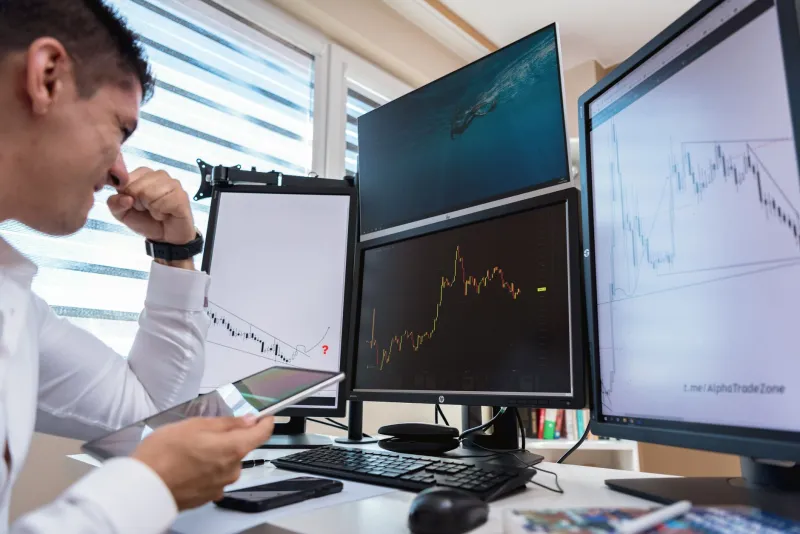
The Information You're Waiting For May Never Arrive
There is a particular kind of investor discipline that looks responsible from the outside but functions as a slow financial drain from the inside. It goes by many names — due diligence, patience, prudence — but its defining characteristic is a willingness to remain in a holding pattern indefinitely while waiting for one more data point, one more earnings report, one more Federal Reserve statement before committing capital.
This is not caution. It is, in most cases, a sophisticated form of inaction dressed up as strategy.
The financial markets do not reward certainty-seekers. They reward those who can make sound probabilistic decisions under conditions of irreducible uncertainty. And for the independent investor managing their own capital, understanding the true cost of waiting — not just emotionally, but mathematically — is one of the more important concepts to internalize.
What Opportunity Cost Actually Means in Practice
Opportunity cost is a term investors encounter early and often, yet it tends to be applied narrowly — usually to the choice between two specific assets. Its more insidious form operates in the space between intention and action.
Consider a straightforward scenario. An investor identifies a position they find compelling in February. The thesis is sound. The valuation is reasonable. But the macro backdrop feels uncertain — inflation data is mixed, the Fed's next move is unclear, and earnings season is approaching. So they wait.
By May, three of those four concerns have resolved. The position has also appreciated 18%. They buy in. The trade still works, but a meaningful portion of the return has already been realized by someone else — someone who acted when the picture was merely good enough rather than perfectly clear.
This pattern repeats itself across market cycles with remarkable consistency. The irony is that the periods of highest perceived uncertainty — early recovery phases, post-correction rebounds, the weeks following an unexpected policy shift — are frequently the periods that generate the most asymmetric returns for those willing to act.
The Psychological Architecture of Delay
Understanding why investors wait requires looking past the stated rationale. In most cases, the desire for more information is not really about information at all. It is about reducing the psychological exposure that comes with being wrong.
Behavioral finance researchers have documented this tendency extensively. Loss aversion, as originally characterized by Kahneman and Tversky, suggests that the pain of a loss registers approximately twice as intensely as the pleasure of an equivalent gain. When an investor delays a decision, they are not simply gathering data — they are deferring the moment at which they become accountable for an outcome.
This is a rational emotional response. It is also a financially destructive one.
The market does not pause while you deliberate. Every day spent waiting is a day in which capital is either deployed elsewhere at a lower expected return, sitting in cash being eroded by inflation, or simply idle. None of these outcomes are neutral. All of them carry a cost.
How Much Clarity Is Actually Enough?
This is the more productive question — and one that most investors never explicitly ask themselves. Instead of operating with an undefined threshold for action, independent investors benefit from building a deliberate decision framework anchored in conviction rather than certainty.
A useful starting point is what might be called the asymmetric clarity test. Before waiting for additional information, ask two questions:
First: What is the specific piece of data I am waiting for, and how materially would it change my thesis if it came in differently than expected?
Second: What is the expected return I am forgoing for each week or month I delay, and is that cost justified by the probability that the new data would actually change my position?
In many cases, honest answers to these questions reveal that the investor already has enough information to act. The additional data being sought would shift the thesis only marginally — but the cost of waiting is concrete and compounding.
A secondary framework worth considering is base-rate anchoring. Rather than evaluating a decision in isolation, examine how similar setups have historically resolved. If the category of opportunity you're evaluating has worked out favorably in seven of ten comparable historical instances, waiting for an eighth data point to push that ratio higher is often a poor trade.
Position Sizing as a Middle Path
One of the more practical tools available to investors who genuinely face meaningful uncertainty is calibrated position sizing. This is not a compromise — it is a disciplined acknowledgment that conviction exists on a spectrum, and that portfolio construction should reflect that.
If your analysis supports a full position but your uncertainty level warrants caution, initiating at half or two-thirds of your target allocation allows you to participate in the move while preserving capital to add as clarity improves. This approach converts the binary choice of act-or-wait into a more nuanced deployment strategy.
The key discipline here is defining in advance what conditions would prompt you to complete the position. Without that pre-commitment, partial positions have a way of remaining partial indefinitely — which is simply a slower version of the same paralysis.
The Compounding Math of Missed Entries
It is worth being direct about the long-run arithmetic. Assume an investor misses the first 15% of a move on four separate positions per year due to delayed entry — not catastrophic misses, just the ordinary friction of waiting too long. At a $500,000 portfolio level, that translates to $30,000 in foregone gains annually. Over a decade, with even modest compounding, the cumulative impact exceeds $400,000.
That figure does not appear on any account statement. There is no line item for "cost of hesitation." But it is as real as any fee or tax drag, and it scales with portfolio size in ways that should concentrate the mind considerably.
Acting Well Without Acting Rashly
None of this is an argument for impulsive decision-making or for dismissing the value of rigorous analysis. The independent investor's edge, when it exists, typically derives from disciplined thinking — not from speed alone.
The distinction worth preserving is between analysis that sharpens a thesis and delay that merely postpones accountability. The former is a genuine input into decision quality. The latter is a psychological comfort mechanism with a measurable financial cost.
Markets are not designed to reward those who wait for consensus. By the time a picture is truly clear, it is usually reflected in the price. The investor who has learned to act on well-reasoned conviction — accepting that some uncertainty is permanent and that imperfect information is the only kind available — is operating closer to how markets actually function.
Perfect clarity is not a precondition for sound investment decisions. It is, more often than not, the thing that arrives just after the opportunity has passed.